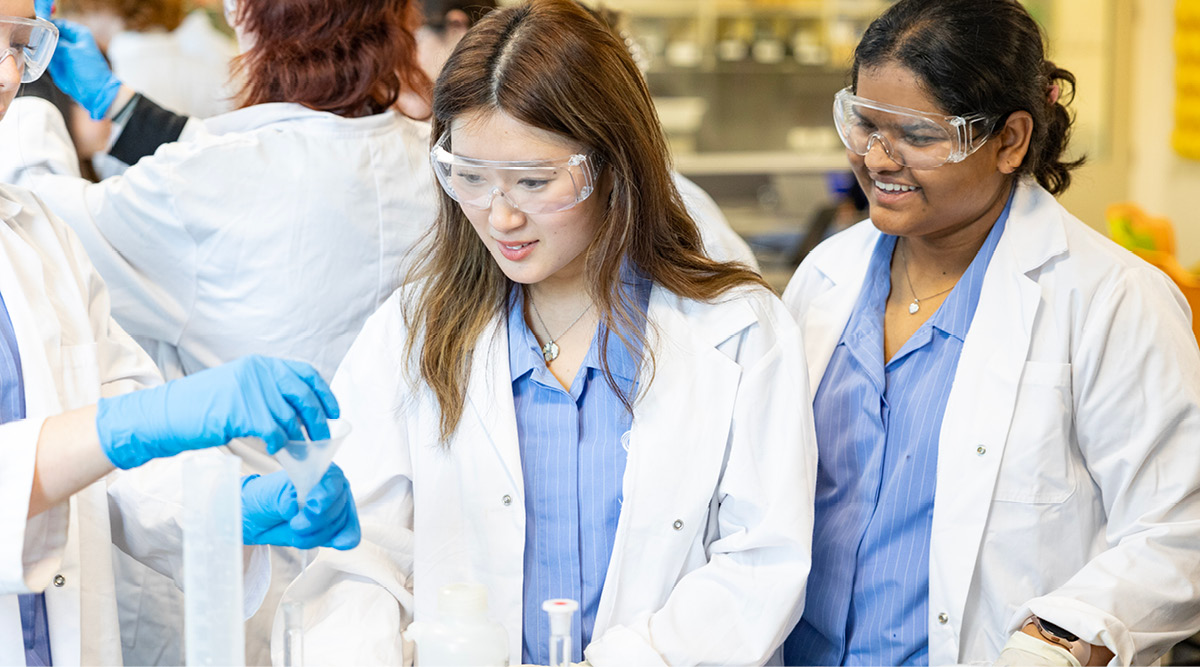
When students commence Year 10 at Queensland Academies Creative Industries (QACI) they will study Science as their group 4 subject.
This Science course is designed to enable all students to acquire and develop the prerequisite skills and understandings, and to prepare students for the IB Diploma Chemistry, Biology, Physics and Environmental Systems and Societies (ESS) courses. This course adopts an inquiry-based approach to learning and utilises innate student curiosity to explore beyond the relevant Australian Curriculum aims and skills and into the IB perspectives about the nature of science and international mindedness with links to the theory of knowledge.
Students are then empowered towards the decision of which science area(s) they would like to pursue in the second semester via the SET Plan process in term 2.
By the end of Year 10 students explain the processes that underpin heredity and genetic diversity and describe the evidence supporting the theory of evolution by natural selection. They sequence key events in the origin and evolution of the universe and describe the supporting evidence for the big bang theory. They describe trends in patterns of global climate change and identify causal factors. They explain how Newton’s laws describe motion and apply them to predict motion of objects in a system. They explain patterns and trends in the periodic table and predict the products of reactions and the effect of changing reactant and reaction conditions. Students analyse the importance of publication and peer review in the development of scientific knowledge and analyse the relationship between science, technologies and engineering. Students will analyse the key factors that influence interactions between science and society.
Students plan and conduct safe, valid and reproducible investigations to test relationships or develop explanatory models. They explain how they have addressed any ethical and intercultural considerations when generating or using primary and secondary data. They select equipment and use it efficiently to generate and record appropriate sample sizes and replicable data with precision. They select and construct effective representations to organise, process and summarise data and information. They analyse and connect a variety of data and information to identify and explain patterns, trends, relationships and anomalies. They evaluate the validity and reproducibility of methods, and the validity of conclusions and claims. They construct logical arguments based on analysis of a variety of evidence to support conclusions and evaluate claims. They select and use content, language and text features effectively to achieve their purpose when communicating their ideas, findings and arguments to diverse audiences.
Once students have completed Year 10 science, a selection is made to study and Standard Level (SL) or Higher Level (HL) Chemistry, Biology, Physics or Environment Systems and Societies (ESS).
Year 10 Science Assessment
- Research-based Investigations
- Experimental Investigations
- Examination style questions